The Bluetooth Car Audio Streaming Conundrum

March 25th, 2014
This is the story of the journey I’ve taken to my current car audio streaming solution, and the devices I’ve tried and abandoned along the way. Maybe some of this information will be of use to you, as it describes solutions and pitfalls related to the bluetooth streaming of audio from a phone or tablet to a car stereo. A followup post will describe how to do it better.

Sometimes one just needs to take a break from endless projects and geekery and just go for a drive and listen to some music. It’s the American way to hit the road and then hit play. That phone you carry around is just waiting to play tons of high quality music from its gargantuan internal storage, or stream music from the net as if you’re living in the post-cloud era.

We Want Wireless


But what’s that you say? Your car doesn’t have built-in bluetooth music streaming, and it’s annoying to have to connect a cable from your phone jack to your car stereo’s aux input every time you get in the car? Maybe you’re worried about wearing-out the phone’s headphone jack, or you’d rather be able to run a true line-level output to the car stereo’s aux input 1 The simple answer is to just buy a Bluetooth car audio receiver such as the Soundfly BT, which plugs right into your car’s cigarette lighter outlet or whatever they call that port these days 2. The Soundfly BT will power up with your car, your paired phone will automatically redirect its audio output to it via the Bluetooth A2DP service, and music will play from the Soundfly BT’s line out port to your car stereo’s aux input or it’ll broadcast to your car stereo’s radio receiver using the device’s built-in FM transmitter.

Apart from the fact that bluetooth audio transmission uses lossy compression 3 and theoretically could degrade the audio a bit, this thing sounds great and is a pretty ideal solution. Unless, that is, your car is like mine, and features an excellent built-in bluetooth speakerphone system that you’d like to continue to use.

Trouble in Paradise: The Bluetooth Speakerphone War

Because the Soundfly BT also features a (horrible) mic and can be used as a speakerphone, it has registered itself with your paired phone as both a Hands-Free and an A2DP audio streaming device. The. Horror.

Your new bluetooth music receiver and your car speakerphone are now at war.

Here’s how this situation regularly played out for me: I’d be in my car in bumper to bumper traffic on the 101 and I’d get a call about a job. I’d hit the answer button on my steering wheel, and my car’s bluetooth speakerphone would answer the call. I’d hear the caller’s perfectly-clear voice on the car’s dedicated hands-free speaker for about 2 seconds, and then 6 times out of 10 everything would go eerily silent in the middle of a word. My phone had just switched from using the car’s hands free system to the Soundfly BT’s hands free system. If my car stereo was set to play from its aux input, there would be a second of silence as the connection switched and then I’d hear (coming from the stereo) the concerned caller repeating my name adorned with question marks. I’d talk back and they’d barely able to make out what I’m saying because of the aforementioned awful mic.

Driving in Songjiang, a suburb of Shanghai.
Keep your eyes on the road! (Especially if you’re driving in Songjiang, a suburb of Shanghai)
That was the best-case-scenario with the Soundfly BT in my car. It didn’t go so well if my stereo was not already set to the aux input, because this meant that in order to hear the caller at all I’d have to manage to switch the stereo to that input while driving, a mean feat since I don’t like to take my eyes from the road while the car is in motion to avoid running over babies or dying. Usually the end result was that people would call, I’d pick up, and they’d hear silence until they hung up.

It’s too bad the Soundfly BT doesn’t feature an option to have it not present itself to your phone as a hands-free system, because its A2DP streaming works a treat. For music streaming it’s almost perfect. It even comes with a remote that could conceivably control your connected device but will instead sit in the glove compartment unused, forever. It’s not that the Soundfly is a bad device, quite the opposite. I highly recommend it if your car doesn’t have a built in hands-free system that you like. Unfortunately I don’t think any similar device includes a feature to disable its hands-free system –this problem affects the entire product category. Maybe they’re all built around the same chipset and the chip is just incapable of advertising itself to the phone as anything but hands-free + A2DP, or maybe no manufacturer strays from using the reference design and bothers to let the user choose to disable one of its features?

A turnkey solution that I skipped due to cost and possibly-dumb philosophical reasons

At this point a normal person might consider buying a bluetooth car audio device that lacks a hands-free system and is known to turn on with the car and stream just fine. The TuneLink Auto (iOS version , Android version 4 ) looks to have been designed to fit this niche. But I have simple needs, and the TuneLink Auto seems to be positioned as a premium device with features and price to match. I don’t need a device controlled via a custom iOS or Android app 5, all I want is a cheap bluetooth device that turns on when power is supplied to it and supports the bluetooth A2DP profile and can stream music from my phone without issue, auto-reconnect would be a plus.

An unfortunately imperfect solution

I came across the EDUP EP-B3502 Wireless Car Bluetooth Music Receiver and bit the (very low-cost) bullet, for science. This device is almost great. Positives:
  • It doesn’t only charge its internal battery via its micro-USB port, but can run while so connected. That was the deal breaker for the similar BCK-08, a device with which I experimented a few years ago.
  • No hands-free profile – no more war with the car speakerphone!
  • It sounds pretty good, good enough at least. I never did a comparative test, but it seemed like it was maybe a small step down in audio quality from the Soundfly BT. It only costs about $13, and all the bluetooth audio devices are using lossy compression, so my expectations were met.
I used this device for a few weeks and at first it seemed all right. One notable negative is that the device does not power itself on when the car starts and power hits its micro-usb port. I’d have to hold down its large button for a couple of seconds at the start of every journey. The fact that this device didn’t clobber my car’s built-in hands-free system made this nit feel minor and worth tolerating, and I figured at some point I’d add some electronics to complete that circuit automatically. A bigger problem is that the thing would occasionally start overlaying beeps on the music. This always felt random, though my guess is that the device would decide that its battery (which I was not using) was low, or maybe it was trying to communicate some other unnecessary message to me. Whatever the reason, it’d interrupt my music with beeps seemingly at random, and this became a maddening thing. 6

Conclusion

Obviously this tale has to end with the abandonment of bluetooth streaming, a ton more research, the buying of parts, the setting up of development environments in a virtual machine, the compilation of custom firmwares, and a switch to the use of uncompressed 7 audio transmission over wifi to a hacked USB-powered router connected to a decent USB DAC. But that deserves its own post.

  1. If you’re lucky-enough to have such an aux input. ↩︎
  2. The “absurdly-deep friction-dependent smartphone and vaping device power outlet”? ↩︎
  3. Bluetooth A2DP, used for audio transmission, “supports optionally: MPEG-1, MPEG-2, MPEG-4, AAC, and ATRAC (shudder), and is extensible to support manufacturer-defined codecs, such as apt-X.” Wikipedia: Bluetooth profile, Advanced Audio Distribution Profile ↩︎
  4. A2DP is a cross-platform standard, and I can’t think of a good reason why whatever custom interface is used to communicate with the thing’s iOS and Android apps (bluetooth serial?) couldn’t be used for both iOS and Android. Why are there different versions of this device? ↩︎
  5. In fact, I see such a device as less valuable than a simpler device –it’s not unlikely that the device’s custom iOS app will not work years from now when our phones are running iOS v15 on 256-core CPUs. I’d rather the device have a non-proprietary control method not tied to custom software, such as a web interface, or some hardware buttons and an LCD. Why unnecessarily tie the future of a spend piece of hardware to software that could quickly become obsolete? ↩︎
  6. Honestly guys, it’s the 21st century, we shouldn’t have to decipher beeps or sequences of flashing LEDs any more than we should have to program computers with punch-cards. Instead of beeping, say what the problem is, in a language that is spoken in your target market. ↩︎
  7. well, non-lossy compression ↩︎

What’s likely coming in the next GoPro (Hero 4) – 4k 30fps, 2k 120fps!

March 18th, 2014

If the specs for the next version of the system-on-a-chip system used in the GoPro Hero 3 are any indication, the next GoPro is going to have some ridiculous specs. 4k-resolution at 30 frames-per-second, 120fps 2k, 240fps 720p, better dynamic range, quality, etc etc etc. The Ambarella A9 sounds like a monster.

I’m looking forward to the cameras the next couple of years will bring. Now if I could just focus on writing something worth shooting…

How to rank the latests slate of Amazon pilots?

February 28th, 2014
2/27 stars, votes, and imdb rating of Amazon's 2014 pilots
2/27 stars, votes, and imdb rating of Amazon’s 2014 pilots

It’s nearing the end of the first month of Amazon’s 2014 pilot season. Amazon, being a company of the digital age, posts all the pilot episodes of their new slate of shows online (here’s a link to view all of them for free) and then tracks how well they’re received by the public. Presumably, the shows that get the most interest and the highest ratings are the ones that Amazon will decide to run for a full season, though I wonder how much or whether the expected production budget of each show figures into the calculation. I worked as assistant editor on The Rebels, so I’m likely a bit more curious than the average person as to how the various pilots are doing. I’ve checked in on the pilots roughly once a week to record their metrics.

There are a few ratings for each pilot that are publicly available. These include the star rating (out of five, rounded to the nearest half-star), number of votes, and imdb rating, listed at the top of each pilot’s page. Further down the page, in the ‘Customer Reviews’ section, is a more precise star rating rounded to the nearest decimal point (i.e. 4.7 rather than 4&1/2).

At right is a table of the current standings of Amazon’s non-kid-oriented pilots as of yesterday, and below are a few graphs showing the trend in those metrics over the past few weeks:

Amazon pilots 2014 trend graphs

It looks to me as though all the pilots have been well received by the very non-random-sampling of Amazon members who choose to both watch and review them, with the minimum star rating hitting 4 out of 5. Only Amazon knows how many viewers each episode has accrued. Bosch appears to be the runaway hit, though I can’t say for certain that this means it’ll be picked up as there are a lot of factors to which I’m not privy –such as the budget for the show and its viewer breakdown. It interests me that The After and Transparent started strong but have seen an fall in their star (and for Transparent, also its imdb) ratings over time. Until I get around to watching all the pilots I keep in mind that it’s possible that this just means the people who are most likely to enjoy those shows are the ones who were first in line to watch them, and the downward trend has nothing to do with how much I will like them. The Rebels seems to have had a pretty consistent reception, with a center of the pack star rating and a steadily rising IMDB rating. The number of votes for The Rebels and Mozart In the Jungle have been almost identical at every moment I’ve sampled, so that’s why they obscure each other in the “number of votes” chart below.

football, comedy, sex, drugs, swearing, and a monkey

February 7th, 2014

The Rebels iconJust a few weeks ago I finished working as assistant editor on the pilot episode of The Rebels, and now Amazon has put it up for free viewing as part of their new batch of pilots. If you like football, comedy, sex, drugs, swearing, or monkeys, you may find exactly what you seek right here. I guess the Amazon way is to post Pilots, let the public watch and vote, and then they decide which go to series.

There were a lot of talented people involved, including Lando Calrissian himself. I don’t mean to spoil anything, but keep an eye out for Billy Dee Williams giving this century’s most brilliant deadpan line reading (I’m speaking of the moment just before he says “Do you know what that means?”  You’ll know it when you see it. The performance transcends the content of the joke).

I executed a few of the show’s VFX,  shots that are a little more ambitious than my norm. I may post a breakdown or two when I have time. I think they’re seamless but if you spot ’em let me know.


Strength of Coffee vs. strength of wasabi/soy mixture

October 17th, 2013

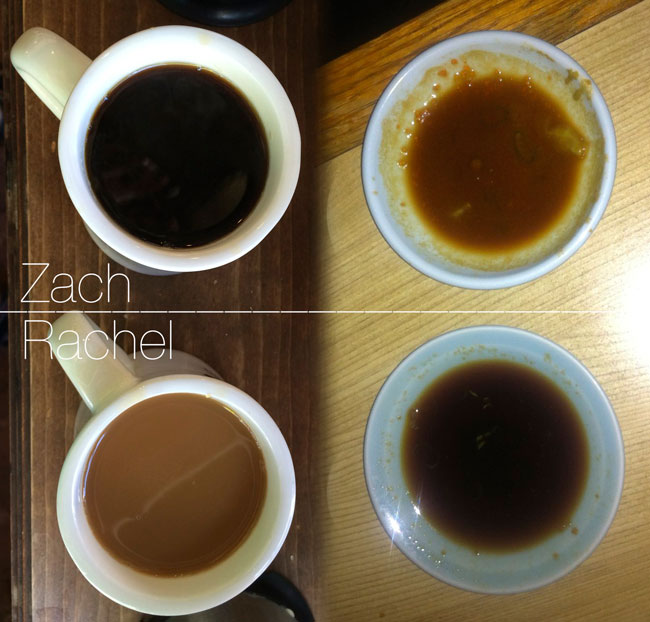
I realized that the difference in color between Rachel’s coffee and mine is generally a mirror image of the difference in color between the wasabi/soy mixtures we each stir up when we order sushi. It felt deserving of a quick infographic:

Zach-And-Rachel-Coffee-And-Wasabi-Preferences

Davinci Resolve 10 public beta is nifty

September 17th, 2013
I graded 1 a short documentary in Davinci Resolve 10 public beta yesterday, and figure I’d share a couple of observations in case they help others.

 A node tree in DaVinci Resolve
A node tree in DaVinci Resolve. In this example, node 1 is an overall adjustment to the shot, and then nodes 2 through 4 isolate and adjust different areas of the shot separately. In this case, since it’s a moving, handheld shot, the shapes in nodes 2-4 have been tracked to stick to parts of the shot. Resolve comes with an awesome and ridiculously-fast tracker.

  1. When I first launched Resolve 10, I noticed that it could see my Resolve 9 database, but said the database was not upgradeable and thus couldn’t be used. Oy, not good. I did want to carry my ongoing projects into Resolve 10. I did a bit of research, and decided maybe if I switched my Resolve 9 database from a PostgreSQL database to the other kind of database Resolve supports, a disk database, that maybe Resolve 10 would be able to use the data. So I reinstalled Resolve 9, created a disk database, selected it, and imported each of my Resolve 9 projects one by one (this took a while). I followed the procedure outlined in an unrelated post by Peter Chamberlain of Blackmagic on their forum:
    In the database manager you can make a new Disk Database. Then make that the active DB. In the Project Manager you can select the global list of databases and select your v9 projects to import to your new Disk DB.

    This worked. When I reinstalled and launched Resolve 10, it was able to use the disk database I’d created in Resolve 9. I don’t know if the steps I took will be necessary in future versions of Resolve 10 (and I’d hope they are not, and that either the app will be able to upgrade PostgreSQL databases to its format or convert them to disk db for you), but at least this is a method that works now.

  2. Resolve 10 brings with it some delightful new features — one can now apply unlimited numbers of shapes (or “power windows”, to use the world’s worst dumbest-sounding name for a shaped selection) to a node. Multiple circles and polygons affecting the effect of a single node, check! The new ‘gradient’ shape is great, though it does seem to render to screen more slowly than the other shapes. I was excited to try out the trial version of the NeatVideo OpenFX plugin for noise reduction, but though I could apply it to a node, I got a “no parameter is exposed to the user” when trying to use it. Hopefully NeatVideo or Blackmagic will get that working. Optical flow interpolation for speed changes sounded like a very cool thing, something I use all the time in After Effects, but I got some pretty weird results from it and it seemed to lack much in the way of tweakability.
  3. The program seemed to run with more speed and stability than Resolve 9. Just a subjective observation.
  4. It worked great with my Avid Artist Color / Euphonix MC Color control surface and Eucon 3.0, but would lose the connection to the control surface every time I switched applications or Resolve was pushed to the background by an alert from some other app. I posted to the Avid forum, and a rep got on the case very quickly. Hopefully this issue gets resolved 2 soon.
If you’ve been thinking of trying out Resolve, you might as well give it a look. It’s a pretty amazing application, and it’s fantastic that BlackMagic lets us all go to town with the barely-crippled “Lite” version for free 3

I’ll link to the documentary short when it’s online.

  1. Grading is the process of adjusting the images in a video or film. Bulk adjustments like brightness, contrast, gamma, saturation, and hue. Localized adjustments within shapes tracked to objects on screen, or limited by the color or brightness of objects in the shot. It’s basically like editing images in Photoshop, except these are moving images. Every feature film and TV program goes through the grading process these days, and by grading one can really spice up or bring out the beauty of the imagery, match shots to one another, give the whole piece a “look”, or just balance things out. It’s to filmmaking what darkroom artistry was for photographic pictures, back when people shot stills on film. ↩︎
  2. I did not intend this as a pun as a typed, but recognized it as I saw the word form. Groan if you must, I’m leaving it. ↩︎
  3. OK, maybe it’s not exactly free, since it’s an engine to drive sales of their video output hardware –the only way to display a true video output signal from the software. But their video output cards are solid. ↩︎

a fantastic ftp client for mac is 50%-off for another 12 hours or so – Panic’s “Transmit”

September 16th, 2013

Looks like my favorite ftp client for mac is 50%-off for a day, on their website and in the mac app store (and app store purchases can be used on all your computers). If you don’t have it, I wouldn’t hesitate to recommend it. It’s a fantastic ftp client, which also supports dropbox, Amazon S3, and other services. It’ll also let you access ftp servers as if they’re disk drives. Nothing I’ve used comes close, except NcFTP at the command-line (and Transmit is using NcFTP behind the scenes). I paid double its current $17 price, and feel like I got a good deal.

If you do much transferring of media or projects to and fro via ftp, you should grab this.

Now working on — We Are Men

August 18th, 2013
I’m now working as assistant editor on the CBS half-hour comedy We Are Men, which will air this fall. The editorial team is comprised mostly of veterans from the film The Man with the Iron Fists. If you’re curious about the show, here’s a surprisingly comprehensive cutdown of the half-hour pilot episode 1:

It’s been a long time since I worked on a TV show, in fact my previous experience might not even count. Everything about that show was different. Travel with me back to Beijing, 2006, and feast your eyes on the promo piece I cut for NBA制造 2. This piece was used to sell the NBA-produced “basketball lifestyle” program to various provincial TV stations:

Man, that show was a challenge, as it featured many interview segments and I barely spoke any Mandarin at that point. My solution was to type in translations of everything as markers on each clip. Eventually I started understanding enough of the interview subjects to not have to look at every marker. The interesting thing about people’s speech is that it becomes possible to parse out the different blocks of meaning and cadences well enough to edit it even without perfect understanding.

But back to the new show; We Are Men will air Mondays at 8:30PM, starting on September 30, 2013. It’s exciting to be working on something with quick turnarounds that’ll actually be seen by the public within months or weeks of shooting. Most of the films on which I’ve worked featured more than a year of postproduction. It’s like being back in a newsroom, except we’re making a fictional comedy rather than rushing to cover breaking stories. It’s also fun working on a comedy, as whenever I pass either the writers room or the editor’s suite I hear plenty of laughter. It lightens the day.

  1. At 20% of its original length it ends up feeling very very hyper, an impression increased by the occasional whoosh transition –but it wouldn’t really be a promo piece if it were the same length and speed as the original. And we’re all raised on video games these days, right? It’d be fun to drop such a promo in front of tv-watchers of the late 50s and see if their heads explode from information overload. Blipverts! ↩︎
  2. literal translation: “Made In NBA”. A cute play on the phrase “Made In China”. ↩︎

Trailer for Spike Jonze film “Her” has been released

August 18th, 2013
Poster-Xlarge
I spent the last year-and-a-half working on this film and, upon request, attempting to give spoiler-free explanations of its content to friends and relatives. Now I’m freed from that responsibility 1 by the Warner Bros. Pictures marketing department. Thanks Brothers!

The trailer for the new Spike Jonze film, “Her”, has been released and can be found on both YouTube and Apple Trailers. I’d recommend watching the Apple Trailers version as even at the HD setting the YouTube version is a surprisingly poor quality encode, or maybe it was downgraded automatically for my poor connection at work while Apple’s site deigned to make me wait for the higher bitrate (Apple Trailers’ preference and mine for quality over convenience match in this instance).

I’m so happy that some of the film is now on display.

For fun, see if you can spot any VFX shots. It’s amazing how seamless and ubiquitous those are these days. I think there may be 17 or so in there, all in place to help tell a story rather than simply to wow the audience or call any attention to their presence.

  1. I’m referring to the need to explain the storyline, not the responsibility of working on the film –though I have moved on to another project ↩︎

Anyone else curious when Filemaker Pro 13 will be released?

July 22nd, 2013

graph of days elapsed between releases of filemaker pro


This spreadsheet is the sort of thing I’ve done in order to guess the release date of a piece of software or hardware I’m waiting to buy. Rachel thought it was funny and encouraged me to post it here as an example of overkill/OCD.

–But maybe there’s at least one person out there waiting for the new Filemaker who’ll find this information useful. The Filemaker Developer Conference is coming up on 8/12/13. I bet version 13 of Filemaker Pro drops that week. It’s overdue if the long development cycle for Filemaker 12 is an anomaly and not a trend.